Every few years, a new hiring channel arrives with the promise of changing recruitment forever. Job boards were going to democratize hiring. LinkedIn was going to make every candidate findable. Programmatic job advertising was going to put the right role in front of the right person at the right moment. Today, AI sourcing tools and one-click applications are the shiny new thing.
Each of these innovations has earned a place in the modern talent acquisition toolkit. Yet when you look at the data on who actually gets hired, who performs well, and who stays, one channel keeps rising to the top. It isn’t new, it isn’t flashy, and it has been around for as long as people have had jobs and friends who needed them.
It’s the employee referral.
In this edition, we look at what the latest US data tells us about referral hiring in 2026, why referrals are arguably more valuable now than they were five years ago, and why so many organizations still leave this channel underused.
A tiny slice of applicants, a huge slice of hires
The single most striking thing about referrals is the gap between how many candidates they produce and how many hires they produce.
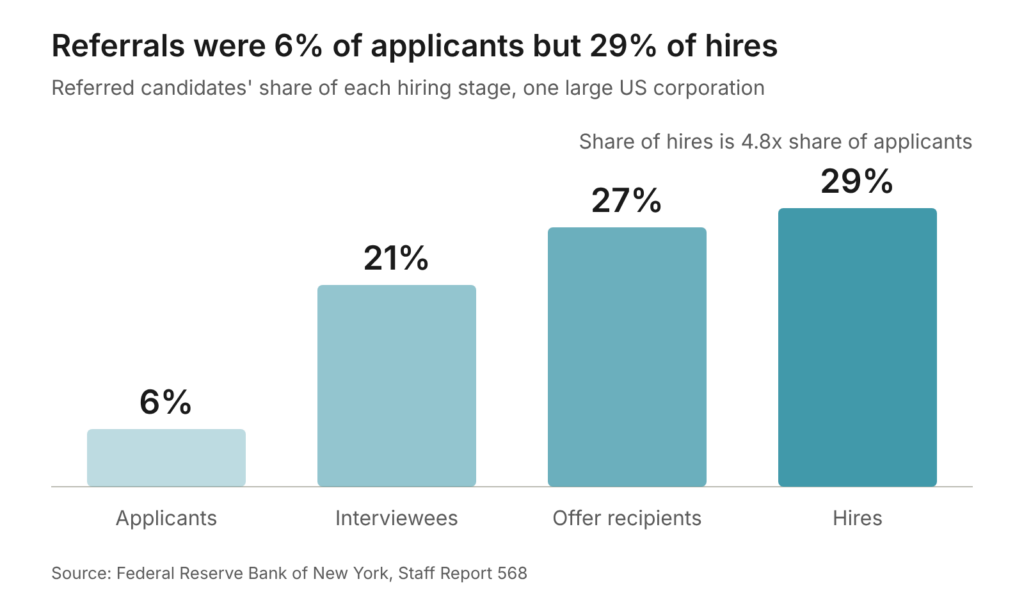
A landmark study by the Federal Reserve Bank of New York analyzed the hiring records of a large US corporation. Referred candidates made up just 6% of applicants, yet they accounted for 21% of interviewees, 27% of offer recipients and 29% of hires. Put simply, a referral’s share of hires was nearly five times its share of the applicant pool.
More recent applicant tracking system (ATS) data tells the same story at enormous scale:
- 11x the conversion rate. Gem’s 2026 Recruiting Benchmarks, drawn from more than 165 million applicants and 1.2 million hires, found that referrals convert to hires at 11 times the rate of inbound applicants.
- About 1% of applications, about 18% of hires. Ashby’s analysis of nearly 250,000 hires found referrals consistently deliver around 18% of hires, while its referral report shows they make up roughly 1% of applications.
- Better at every stage. In Ashby’s data, 40% of referred applicants reach an interview, and its 2026 operations benchmarks show 52% of referred candidates pass the initial screen, compared with 35% overall.
No other external channel comes close to that level of efficiency. Job boards and careers sites generate volume. Referrals generate hires.
Speed: skipping the slowest part of the funnel
Hiring in the US is still slow. SHRM’s 2025 Recruiting Benchmarking data, based on 2,371 US HR professionals, puts the median time-to-fill at about a month and a half for both executive and non-executive roles. At extra-large organizations (5,000+ employees), it stretches to around 61 days for non-executive positions.
Much of that time is spent at the top of the funnel: posting, waiting, screening and filtering. Referrals short-circuit that stage. A referred candidate arrives with context, and someone inside the business has already vouched for their skills and fit. That’s why referred applicants pass initial screens at a far higher rate than the average applicant, and why recruiters can move them to interview quickly.
The same SHRM study found that recruiters at large organizations manage around 50 to 60 requisitions each per year. When workloads look like that, a channel that hands you pre-qualified candidates isn’t a nice-to-have. It’s capacity.
Quality and retention: referred hires perform better and stay longer
Getting someone in the door quickly only matters if they turn out to be a great hire. Here, too, referrals lead.
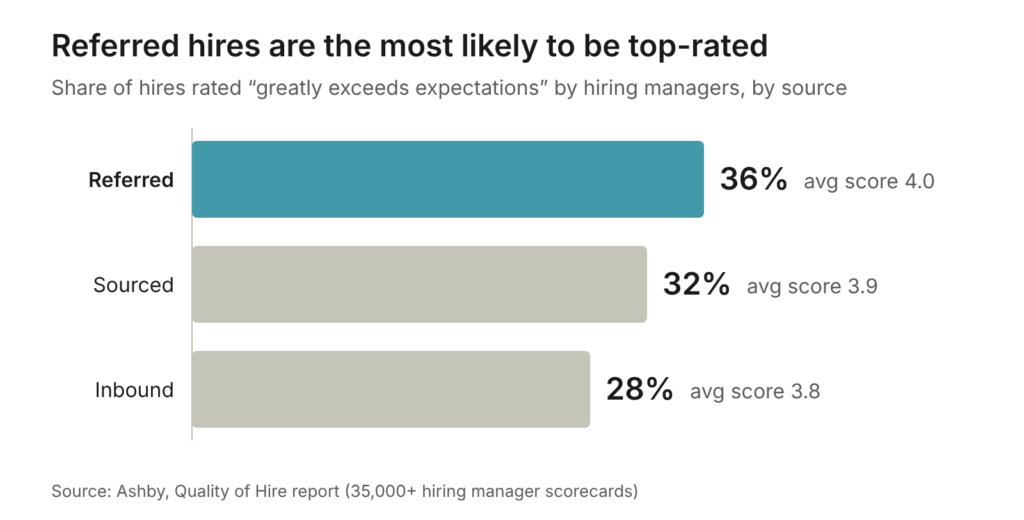
They perform better. Ashby’s Quality of Hire report, based on more than 35,000 hiring manager scorecards, rated referred hires 4.0 on its quality scale, compared with 3.8 for inbound applicants and 3.9 for sourced candidates. The gap widens at the top end: 36% of referred hires were rated “greatly exceeds expectations”, versus 28% of inbound hires.
They accept offers more often. Ashby also reports that referred candidates have higher offer acceptance rates than both inbound and sourced candidates, across business and technical roles. Fewer declined offers means fewer restarted searches.
They stay. Retention is where the evidence for referrals is strongest and most consistent across US research:
- An iCIMS study of more than 50 companies and 91,000 employees found the median referral hire stayed 38 months, compared with 22 months for non-referral hires. That’s 70% longer. In high-turnover industries, referral hires stayed 122% longer.
- The New York Fed study found referred workers were only about 85% as likely to leave as their non-referred colleagues.
- Research across nine large US firms in call centers, trucking and high-tech, published by IZA, found referred workers were 10% to 30% less likely to quit.
- A field experiment published by the National Bureau of Economic Research found referred hires had 45% lower attrition than comparable non-referred hires.
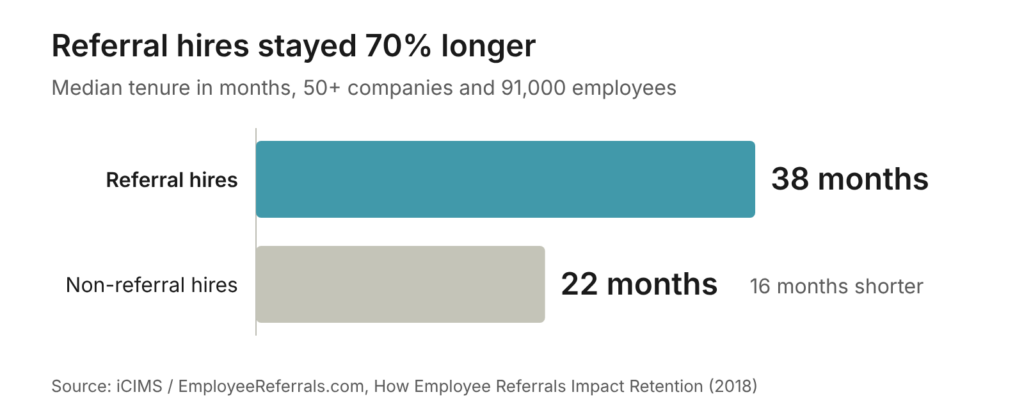
There’s a knock-on effect, too. iCIMS found that employees who make referrals stay about 20% longer than standard hires. A healthy referral program doesn’t just bring in people who stay. It helps keep the people you already have.
Cost: look at the lifetime of the hire, not just the invoice
It’s tempting to compare channels on upfront cost alone. By that measure, US hiring can look fairly cheap at entry level. SHRM’s 2025 benchmarking puts the median cost-per-hire at $1,200 for non-executive roles. For executive roles, however, it has climbed to $10,625, up 113% since 2017.
But upfront cost-per-hire tells only part of the story. The real expense comes when a hire doesn’t work out and you pay to fill the same seat twice, plus the lost productivity, onboarding time and team disruption in between.
This is where referrals change the math. iCIMS calculated that because referral hires stay so much longer, the costs of replacing them are incurred 41% less often. Its conclusion: over the life of the hire, a referral costs roughly half as much as a non-referral.
To be fair, referrals aren’t free. You’ll typically pay a referral bonus, and the New York Fed study found referred hires started on salaries about 2.1% higher. Even so, against an agency fee or a replacement hire six months later, the economics are hard to argue with.
The bigger problem is that most organizations can’t see this clearly. SHRM found that only 20% of US organizations measure quality of hire, down from 27% in 2022. If you aren’t tracking retention and performance by source, the true value of referrals stays invisible on the balance sheet.
Why referrals matter even more in 2026
You might expect referrals to fade as hiring technology improves. The opposite is happening.
Over the past few years, generative AI and one-click apply have made it easier than ever to send out applications at scale. Recruiters now face a flood of polished résumés and tailored cover letters, many of which look strong on paper. Ashby’s data shows inbound application volume roughly tripled over the period it studied, while the rate at which inbound applicants received offers fell by about 70%, from around 7 in 1,000 to just 2 in 1,000.
In that environment, the hardest thing for a recruiter isn’t finding candidates. It’s finding signal.
That is exactly what a referral provides. A referral is a human endorsement from someone who knows the role, knows the team and is putting their own reputation on the line. No algorithm can fully replicate that trust. Ashby found that referrals stay consistent at around 17% to 18% of hires regardless of how many inbound applications a role attracts. The noise goes up; the referral signal holds.
Referrals also give you something job boards can’t: access to passive talent. Many of the best people aren’t scrolling job listings. They’re happily employed, and they’ll only consider a move when a trusted friend or former colleague taps them on the shoulder.
So why do so many referral programs underperform?
If referrals are this effective, why don’t they make up the majority of hires everywhere? Published figures for referral share of hires range widely, from around 10% at some US employers to more than 30% at firms with strong, formal programs. The difference rarely comes down to the quality of a company’s people. It comes down to the experience the program gives them.
The most common problems we see are:
- The “black hole” effect. An employee refers a friend, then hears nothing. No update, no acknowledgement, no outcome. After one or two experiences like that, they stop referring.
- Out of sight, out of mind. Open roles sit on an internal careers page that nobody visits. Employees don’t know what’s open, so they can’t think of who to recommend.
- Too much friction. Long forms, clunky portals and unclear rules turn a 30-second favor into a chore.
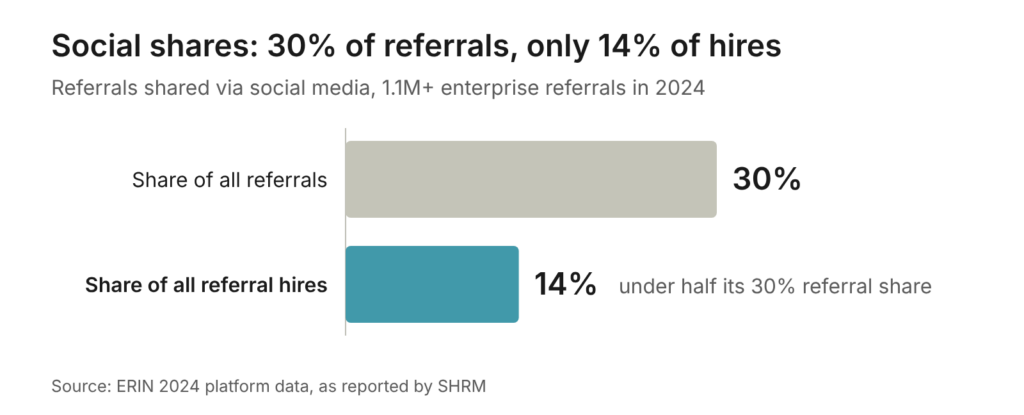
- Broadcast instead of personal. Data covering more than 1.1 million referrals in 2024 and reported by SHRM found that around 30% of referrals were shared on social media but only 14% of hires came from that channel. Direct, personal recommendations convert far better than generic posts.
- Over-reliance on bonuses. Cash incentives help, but research published by the NBER found that bigger bonuses alone produce only modest gains in referral volume. Recognition, visibility and a sense of contribution matter just as much.
- No data. Without tracking referral activity and outcomes by team, role and source, it’s impossible to know what’s working or where engagement is dropping off.
It’s also worth acknowledging a real risk: if referrals come only from a narrow slice of your workforce, they can reinforce existing networks and limit diversity. Well-run programs counter this by promoting roles widely across every team and pairing referrals with structured, fair assessment.
Six steps to building a referral culture that lasts
The organizations getting the most from referrals treat them as a culture, not a policy. Here’s where to start:
- Close the feedback loop. Give every referrer real-time updates on where their candidate stands. Transparency is the single biggest driver of repeat referrals.
- Bring roles to your people. Use targeted campaigns to put the right roles in front of the right teams, rather than waiting for employees to go looking.
- Ask by function. Ashby’s research found referrals are more likely to lead to interviews when the referrer works in the same job function as the open role. Ask your engineers for engineers and your sales team for sellers.
- Make it effortless. A referral should take seconds on a phone, not minutes on a desktop portal. Let employees share roles with their own networks and endorse candidates they know.
- Recognize, don’t just reward. Combine incentives with public recognition, leaderboards and friendly competition, so referring feels valued and visible.
- Measure what matters. Track referral share of hires, conversion at each stage, time-to-hire and, above all, retention and performance by source. That’s how you prove the value of the channel and keep investing in it.
The bottom line
Hiring channels will keep evolving. AI will keep reshaping how candidates apply and how recruiters screen. But the fundamentals of good hiring haven’t changed: trust, fit and people who want to stay.
The data is clear. Referred candidates are a small fraction of applicants but a large share of hires. They convert at many times the rate of inbound applicants, perform better, accept offers more often and stay significantly longer. In a market drowning in applications, a trusted recommendation from one of your own people is one of the most valuable signals you can get.
The question isn’t whether referrals work. It’s whether your program makes it easy for your people to do what they’re already willing to do.
That’s what HireUp is built for. Our employee referral platform puts a referral experience designed around employees at the heart of your hiring: branded campaigns, a mobile app, social sharing, referral endorsements, gamification and real-time tracking that eliminates the black hole effect. It plugs straight into your existing ATS and keeps your program compliant with CCPA, CPRA and GDPR.
Our goal is simple: to help you achieve 30% or more of your total hires through referrals.
Book a demo to see how HireUp can revolutionize your referrals, or check your program’s health with our free Referral Health Calculator.
Sources
- Brown, Setren and Topa, Do Informal Referrals Lead to Better Matches?, Federal Reserve Bank of New York Staff Report 568
- Gem, Key takeaways from the 2026 Recruiting Benchmarks Report
- Ashby Talent Trends: Inbound, Referrals, Recruiting Operations Benchmarks, Quality of Hire
- SHRM, 2025 Recruiting Executives Benchmarking
- SHRM, Majority of Employee Referrals Made During Work Hours (ERIN 2024 data)
- iCIMS, How Employee Referrals Impact Retention (2018)
- Burks, Cowgill, Hoffman and Housman, The Value of Hiring through Referrals, IZA Discussion Paper 7382
- Friebel, Heinz, Hoffman and Zubanov, What Do Employee Referral Programs Do?, NBER Working Paper 25920
Share This Article