

An employee sees an open role and immediately thinks of a former colleague. The experience looks relevant. The opportunity could be a good move. There may even be a referral bonus.
Yet the employee never makes the introduction.
For HR and talent acquisition teams, that hesitation matters. A referral program can offer an attractive reward and still struggle to turn awareness into participation. Understanding why requires looking beyond the incentive to the person making the referral.
A referral connects two relationships: the employee’s relationship with their employer and their relationship with the candidate. A useful way to understand participation is to ask whether employees feel confident putting those relationships together.
Why people refer: the opportunity to help
The invitation to refer often starts with a simple thought: “I know someone who would be great at this.”
That gives employers a practical starting point. A referral message should help employees recognize a real opportunity for someone they know. Explain what the person will do, which skills matter, and why the role could be attractive.
There is encouraging evidence that many American workers are willing to recommend their workplaces. In the American Psychological Association’s 2024 Work in America survey, 81% of respondents said they would recommend their workplace as a good place to work. The survey was conducted online by The Harris Poll among 2,027 employed US adults and included full-time, part-time, and self-employed workers.[1]
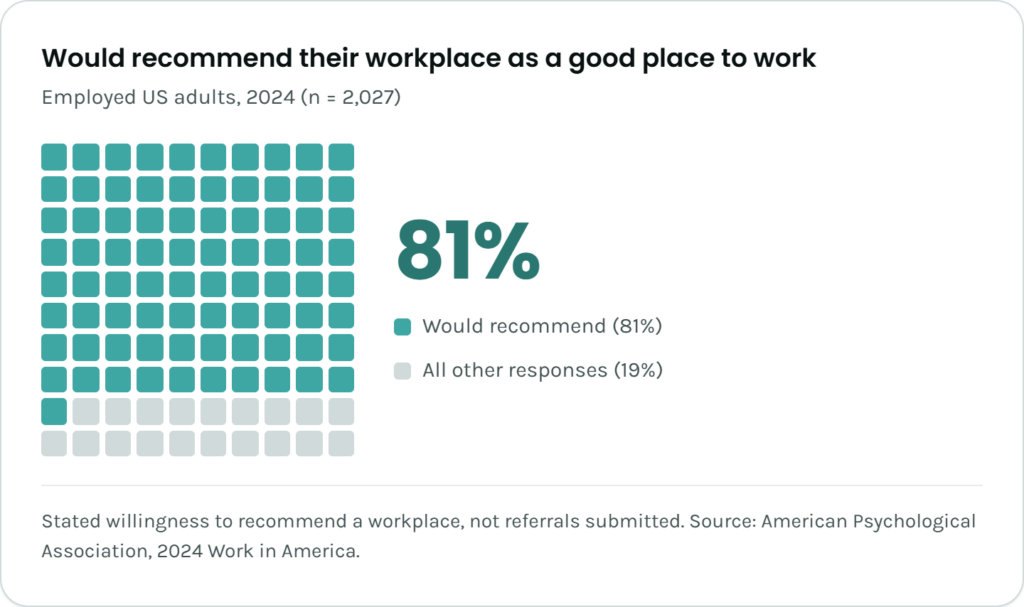
That figure measures stated willingness to recommend a workplace. It does not mean 81% submitted a referral. The distinction is the challenge: employers need to make it easy for a positive opinion to become a specific introduction.
Instead of leading every campaign with the bonus, try leading with the opportunity: “Know a customer success professional who enjoys solving complex problems? Here’s what our team is hiring for.”
Why people hesitate: their reputation is involved
Employees may have two concerns at once: “What if my friend has a bad experience?” and “What if my recommendation disappoints my manager?”
Referral research has explicitly examined the interaction between bonuses, perceived risk in referring, and employees’ emotional commitment to their organization.[2] That provides a more useful framework than assuming participation depends on the dollar amount alone.
For employers, the practical implication is to clarify what a referral means. Employees can share relevant information and explain how they know someone; recruiters remain responsible for evaluating candidates.
Ask for context rather than an unconditional endorsement. “We worked together for two years, and I saw their project management skills firsthand” is more useful than “They’re perfect for the job.”
Make clear that referring someone does not guarantee an interview or offer. A realistic explanation can make the introduction easier for everyone involved.
Why people hold back: they cannot confidently recommend the experience
An employee can like their colleagues while having reservations about compensation, advancement, or management. Those reservations may become especially relevant when they imagine a friend joining.
Pew Research Center’s 2024 survey found that 50% of US workers were extremely or very satisfied with their jobs overall. Satisfaction was lower for specific issues: 30% were highly satisfied with their pay, and 26% with their opportunities for promotion.[3]
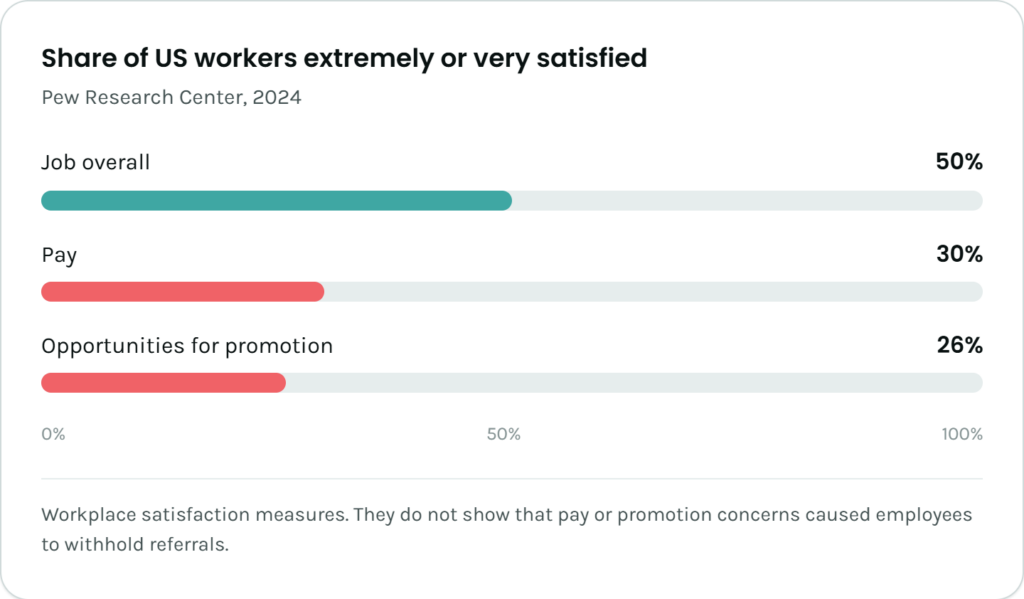
These are workplace satisfaction measures, not evidence that pay or promotion concerns caused employees to withhold referrals. They do, however, suggest useful questions for employers investigating low participation.
Would employees recommend the role’s pay? Can they explain the career path? Would they feel comfortable describing the manager’s expectations?
A short employee survey can surface concerns that another referral reminder will not resolve. Ask what would make employees more comfortable recommending the company, then act on the recurring themes.
Why rewards help-and why the amount is only one decision
A referral bonus gives employees a tangible reason to participate. But the goal should be suitable candidates and successful hires, rather than the largest possible number of submissions.
In a randomized study of a grocery chain, researchers found that larger referral bonuses increased referral quantity but reduced referral quality. Introducing the referral program also reduced overall employee attrition by 15%. The researchers identified employees valuing involvement in hiring as the most-supported explanation for the program’s indirect retention effects.[4]
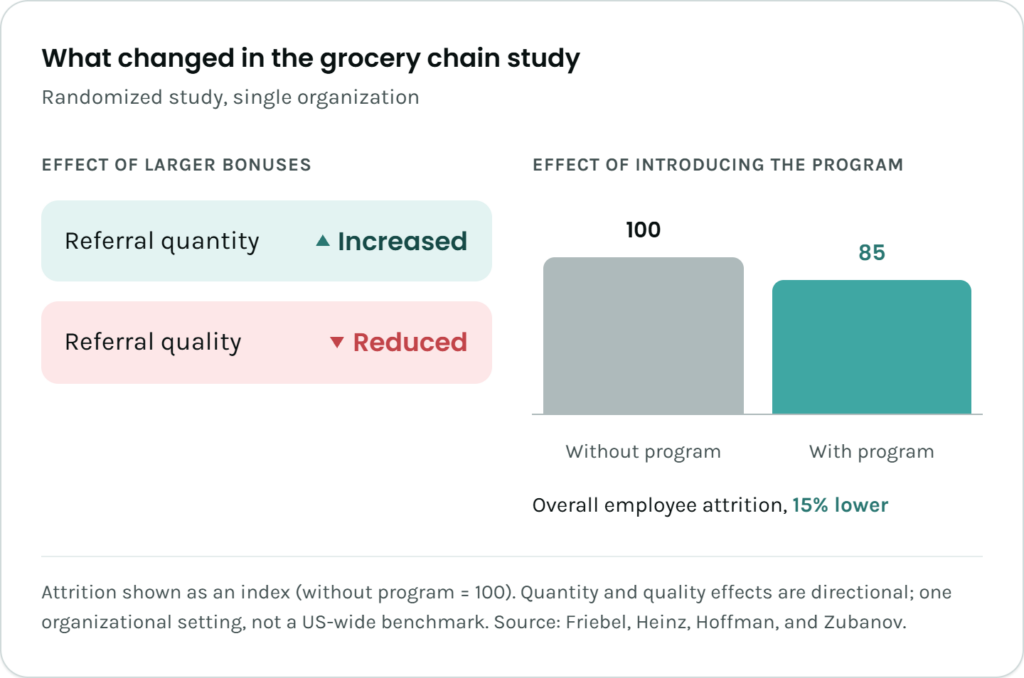
This was a particular organizational setting, not a US-wide benchmark or a promised result for another employer. Its lesson is to evaluate the whole program rather than treating a larger bonus as an automatic improvement.
Make reward rules easy to understand: who qualifies, what triggers payment, and when payment happens. Then assess candidate suitability, hiring outcomes, and retention alongside referral volume.
Why people do not participate: they cannot think of the “right” person
“Refer a friend” is familiar language, but it may encourage employees to search too narrow a circle.
A study published in Science in 2022 analyzed LinkedIn experiments involving more than 20 million people over five years, during which approximately 2 billion connections and 600,000 new jobs were created. The researchers found that weaker ties could improve job mobility, although the relationship was nonlinear and varied across industries.[5]
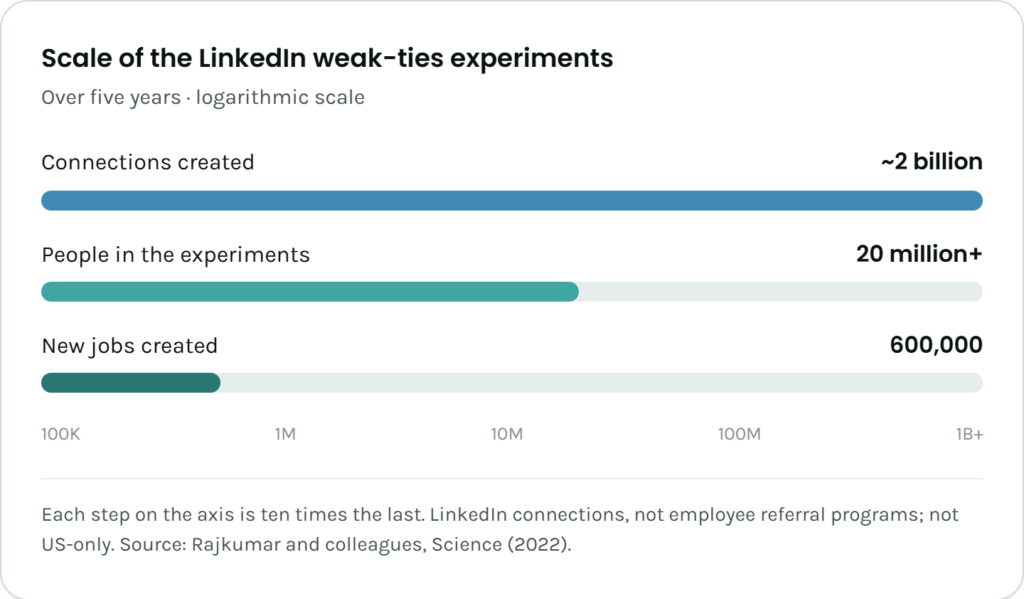
The study examined LinkedIn connections, not employee referral programs, and was not a US-only survey. Its practical relevance is that valuable professional connections can extend beyond close friends.
Prompt employees to think about former coworkers, past project partners, classmates, and professional contacts. Invite them to explain what they know about the person’s work without suggesting expertise they do not have.
Keep job criteria consistent across referred and other applicants. A personal connection should provide useful context while candidates are assessed against the role’s requirements.
Make the next referral easier to make
Even a motivated employee needs a clear next step. A useful program makes it easy to find a relevant opening, share it, understand the process, and see what happens afterward.
Without updates, employees may be left managing awkward questions from someone they introduced. Acknowledging the referral and sharing appropriate status information can help them understand where their involvement stands. This is a program design recommendation, rather than a measured effect from the studies above.
HireUp supports that experience through referral campaigns, social sharing, referral endorsements, and real-time referral tracking.[6] Those tools give employers ways to make opportunities visible and keep employees informed.
The underlying question is personal: “Do I feel comfortable connecting this person with my employer?”
Build a referral program that helps employees answer “yes”, with credible opportunities, clear expectations, straightforward rewards, and a process they can understand.
Ready to improve your employee referral experience?
Explore HireUp and book a demo.
Sources
- American Psychological Association, 2024 Work in America: Highlights. US survey conducted March 25–April 3, 2024. Report and methodology.
- Pieper and colleagues, Motivating employee referrals: The interactive effects of the referral bonus, perceived risk in referring, and affective commitment, Human Resource Management (2018). Research article.
- Pew Research Center, Job satisfaction, December 10, 2024. Findings.
- Friebel, Heinz, Hoffman, and Zubanov, What Do Employee Referral Programs Do? Measuring the Direct and Overall Effects of a Management Practice. NBER working paper, revised August 2022; subsequently published in Journal of Political Economy (2023). Research summary.
- Rajkumar and colleagues, A causal test of the strength of weak ties, Science (2022). Study abstract.
- HireUp, platform overview.
Share This Article